Imperial academic awarded a top honour in structural engineering

Professor David Nethercot talks about his career and receiving the Institution of Structural Engineer’s highest accolade –News
See also...
Thursday 16 April 2009
By Colin Smith
A world leading structural engineer from Imperial College London receives the highest accolade from the Institution of Structural Engineers next week.
The Gold Medal will be presented to Professor David Nethercot, head of Imperial’s Department of Civil and Environmental Engineering, for his services to structural engineering.
As part of this honour, Professor Nethercot will be delivering a Gold Medal Address to industry, academia, students and friends on 23 April 2009. We ask Professor Nethercot to tell us more about his academic career, which spans 40 years of research, teaching, and engagement with the international structural engineering community.
What are the highlights of being a structural engineer?
One of the greatest highlights for me has been carrying out research. It gives me a real thrill to be able to study and understand an area in such detail. Being part of a process that improves our knowledge of structures and how they perform in different circumstances gives me a sense of personal satisfaction. Another career highlight has been leading the Department of Civil and Environmental Engineering at Imperial. This department is the best in the UK and its success is largely down to the high calibre of staff.

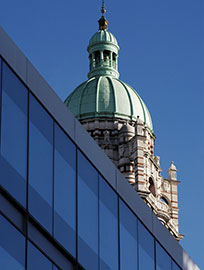
Professor Nethercot has found structural engineering varies in cities around the world because of different environmental factors
What research are you carrying out now?
I am carrying out research into ‘progressive collapse’. The World Trade Centre is an example of a building that progressively collapsed, where each floor fell like a pancake into the floor beneath it, causing the building to plummet to the ground. We have been devising new methodologies that will enable engineers to better manage how buildings withstand impacts to prevent them from collapsing.
How are you doing this?
Working with Imperial researchers and with the construction company Arup, we have developed new modelling methods that will enable engineers to improve their understanding of how structures cope with different impacts. For instance, we can use these models to test what would happen to different building designs if a plane crashed into them, or if it suffered damage in an earthquake. With this knowledge engineers could design buildings that are safer or refit existing ones to make them more robust.
Don’t models and methods like these already exist?
The methods and models we have developed will give engineers a much greater degree of certainty than they have now. They will be able to carry out much more robust testing.
What has interested you most in your career?
The international aspect of structural engineering has always interested me. Structural engineering and the way that it is practiced varies from country to country. This is because our structures are affected by different environmental and social factors. For instance, when I went to Japan for the first time, I was struck by the uniformity of their steel frame buildings. One of the reasons for this uniformity is that these buildings must comply with strict earthquake regulations. Another is their culture, which prizes uniformity and conformity of the individual above all else - this is reflected in their buildings.
What are the challenges of being a structural engineer?
One of the major challenges is to demonstrate to society how valuable structural engineering is to our lives. Engineering is ubiquitous, it is in everything, and this tends to make people forget its importance. I’ve been involved in a number of projects in my career that really prove how important it is to our lives and our safety.
Can you give an example?
In the 1970’s, many countries began to build box girder bridges that comprise of steel beams in the shape of a box. They are used for highway flyovers and for modern elevated structures for light rail transport. However, when they were first being designed and built no one knew that they had structural weaknesses. One collapsed in Melbourne, Australia, and another in Germany. In the UK, Milford Haven Bridge in Wales became unsound. I was asked to be part of a team to improve the design of the bridge. Using computer models that were very sophisticated for their day we were able to pin-point a major weakness of part of the bridge called the diaphragm, which held the boxed girders in position. This led to reinforcements in box bridges around the world, saving them from being dangerously unsound. This is the type of structural engineering work that goes unsung a lot of the time.
What does it mean to you to be a recipient of the Gold Medal?
It is really nice to have the recognition of one’s peers. I know it sounds a bit corny, but you do get a warm glow when people who know you and understand what you’ve done in your career recognise your efforts.
Professor Nethercot will be speaking at Imperial College London at 6pm on Thursday 23 April 2009. For further details and to book a place, contact the events team at the Institute of Structural Engineers at events@istructe.org or call +(0)20 7235 4535.
Article text (excluding photos or graphics) © Imperial College London.
Photos and graphics subject to third party copyright used with permission or © Imperial College London.
Reporter
Press Office
Communications and Public Affairs
- Email: press.office@imperial.ac.uk